Category Archives: News

Head and Neck team – New Video Project

Fresh from the success with the Bright Ideas award, our team are now working on a video covering the various aspects of Peg and Rig feeding. This can be a daunting prospect for new patients, and it was felt that a video would fit the bill, helping patients and carers alike understand what’s involved.

We wish them the best of luck with the video, and hope to get good news on a future award in due course!

UHNM Bright Ideas Award – Head and Neck Team WIN!

Our Head and Neck team have recently won an award for ‘an innovative approach to patient information using audio or video’. Congratulations to all involved.

The team put together videos introducing themselves, and describing their roles. The videos are now a permanent part of the Hospital web page and can be accessed by clicking the link below…

Head & Neck Cancer Team


Binky Bunker???

Anne has given up a considerable amount of time to create a knitted ‘Binky Bunker’ golf doll to be raffled by the Stafford Golf Club Committee at one of their many events.

You may remember the Club chose Headcases as their nominated charity for 2019, and will be having several fundraisers throughout the year.

If we can locate Binky and get him to hold still for a photo, we’ll reveal him here…

Thanks Anne!

June meeting and a talk on Nutrition by Sophie

Our thanks to Sophie Harries, Dietician for coming out to our June meeting to talk about nutrition. We hear all the time about healthy eating and cutting down on calories to lose weight, but during treatment and in the post – treatment period, patients’ needs are very different.

Swallowing food at all can be very difficult after treatment, and it can easily lead to weight loss, which hinders recovery. High calorie foods containing lots of cream, gravy or other liquids help with maintaining weight and are easier to swallow.

All the group members agree that at first, food is a big issue and it’s only after quite a period of time that diets return to a more ‘normal’ form.

We are fortunate to have access to a team of dieticians [ Sophie, Josh and Richard ] who’d be happy to help with any issues arising during and after treatment.

Bye Marie, and don’t be a stranger!

It’s time to say a big thank-you to Marie Clubb, our outgoing treasurer. Marie has been our Treasurer for a number of years now, and has decided it’s time to move on. Marie has made a huge contribution to our meetings and we’ll all miss her. That’s apart from all her efforts behind the scenes as Treasurer!

We all wish you the very best for the future Marie, and here’s a virtual bunch for the time being…

Any takers for the Treasurer post please contact myself or Fred. Fred is carrying out the duties for the time being.

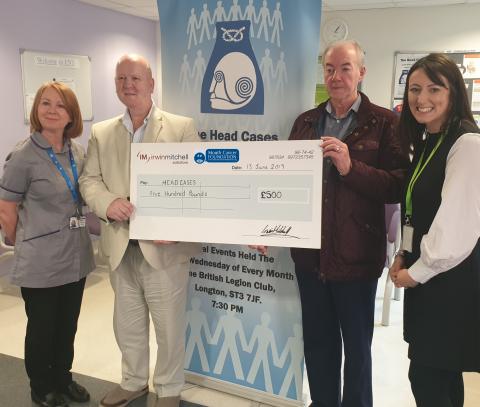
Headcases receive the Mouth Cancer Foundation Bronze Award 2019

Last Thursday we were delighted to accept a cheque from The Mouth Cancer Foundation in association with Irwin Mitchell, Solicitors. The presentation was made by Emma Wagstaff from Irwin Mitchell at the hospital, and the Bronze Award amount was £500.00 which will be paid into Headcases funds to help with our work. From left to right: Wendy, Fred, Russell and Emma. Click the picture to read the story on the MCF site…

We put in an application back in March, and were surprised and delighted to get another award after our earlier success in 2017.

Our thanks to the team at Mouth Cancer Foundation and Irwin Mitchell.

The Mouth Cancer Foundation – Patient Survey

Wendy was recently contacted by the Mouth Cancer Foundation for help with this survey, and I posted the link here to enable patients to join in with this important work.

The Mouth Cancer Foundation is involved with a collaborative group to produce a patient survey aimed at finding out about the patient experience of head and neck cancer patients to gain a better understanding of the quality of life experience for people affected by this type of cancer.

This quick and simple survey is for patients who have received treatment for head and Neck cancer but are not currently receiving active therapy.   It has been created in collaboration with The Swallows Head and Neck Cancer Charity, the Mouth Cancer Foundation and a pharmaceutical company.  We really need your help to inform us, from a patient perspective, how improvements can be made to the care patients will receive in the future.

We would be extremely grateful if you could forward the attached letter to your patients and ask them to take a few minutes to fill out the survey to give us their feedback.

http://medicysltd.decipherinc.com/survey/selfserve/53f/102913?list=1&ID=wYwjtPP4L5


IOPI Medical: What’s Your Tongue Strength?

We had unanimously decided to support the purchase of some IOPI medical equipment in our previous meeting. Our local NHS Trust is unable to fund the purchase of this equipment, which is used to measure, monitor and promote tongue and lip function, especially post-treatment. We tend to take the correct functioning of our tongues and lips for granted, but after surgery or radiotherapy the reduced functioning can impair speech, food retention in the mouth and swallowing.

But what is this equipment? Amy gave up her Wednesday evening to attend our May meeting and explain. To give Amy her full title:

Amy Bainbridge, Speech and Language Therapist – Clinical Lead for Head and Neck Cancer

  1. Objective tongue strength measurements. The IOPI Pro base station is kept in clinic and is used to measure tongue strength and endurance before, during and after treatment. The patient places a bulb on the tongue, which is then pressed against the roof of the mouth. The pressure exerted is measured by the equipment via a tube, connecting the bulb to the unit.
  2. Objective lip strength measurements. The same equipment can be used to measure the lip strength and endurance. The bulb is placed in the corner of the mouth and the lips ‘pursed’ to grip the bulb.
  3. Feedback. The unit gives a visual feedback to the user and clinician, showing how well the patient is doing against a personalised target. The clinician can set up a personalised exercise regime to help improve function, and the LEDs on the unit give a simple feedback to the user.

The IOPI website explains better than I can, and it can be accessed by clicking the logo below..

Our intention is to purchase a Pro unit for use in clinic plus a Trainer unit to be loaned out to patients. The training regime for a given patient is expected to involve a relatively short time, so a single Trainer should be able to support a number of patients. Depending on the results achieved, we may purchase an additional Trainer unit in the future.

It remains to thank Amy for coming along and explaining the what, why and how. Amy’s enthusiasm and dedication are an inspiration! The wheels are now in motion and we should be handing over the equipment in the near future.

Diabetes UK North Staffs – A talk at our May meeting

Our thanks to Malcolm Barber, who attended our May meeting and delivered a very interesting presentation. Malcolm mixed slides, videos and his own personal story to increase our awareness of both types of Diabetes, and what we can do to avoid type 2, the most common variant, accounting for 90% of cases in the U.K. Click on the icon below to visit Diabetes UK North Staffs…

Malcolm is the Education Liaison Officer for the group, and is passionate about raising awareness in our area, especially as Stoke on Trent is a national hotspot for diabetes. Diabetes affects some 4 million people in the UK and is a massive problem for our overstretched NHS.

Top tips for avoiding Type 2:

  • Try to maintain a healthy weight, using exercise to improve health and BMI
  • Limit intake of carbohydrates, which convert easily into sugars
  • Limit high sugar foods – look at the labels and avoid anything whose sugar content exceeds 5% [ or 5g in 100g of product ]

We had a lively discussion prompted by John, who pointed out that post – treatment, cancer patients are encouraged to eat all the ‘wrong’ things in order to gain weight, and promote a normal appetite! I have a feeling that the evening was a two way street, with Malcolm gaining an appreciation of the head cases outlook, and the group receiving some important knowledge about Diabetes.